
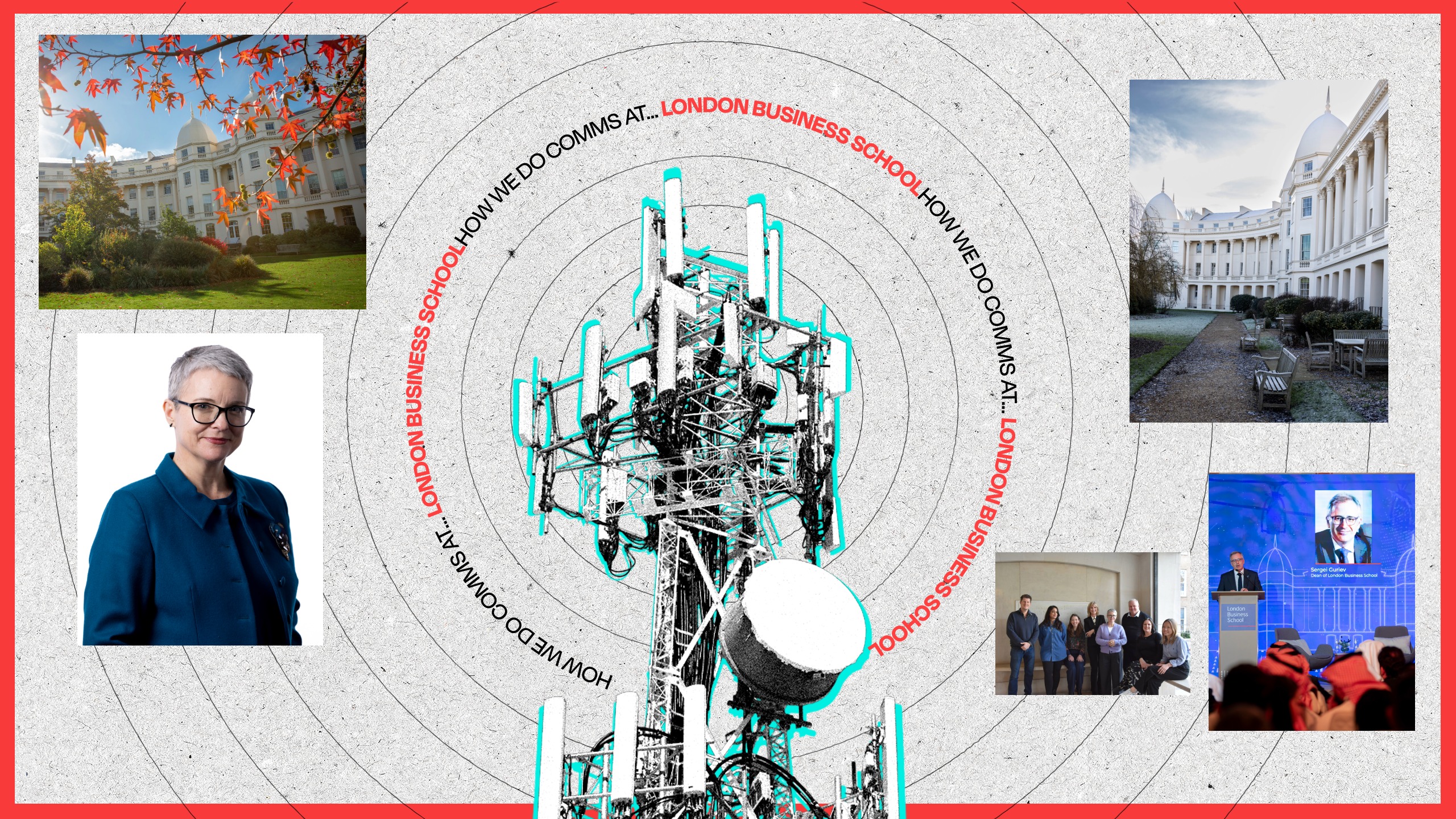
In the second article in our ‘How we do comms at’ series, we talk to Felicity Glennie Holmes, chief communication officer at London Business School.
Tell us a bit about your team. How big is it and how does it fit together?
I have a team of 18 that covers both communications and events. The comms includes 11 people split between internal and external. Internally, we work to make sure that all of LBS’s messaging is consistent across the school. Externally, we align with print, broadcast and online outlets as well as podcasts, so that we’re amplifying not just school news, but the important work our faculty do in education and business research. We have a community manager who nurtures and develops meaningful initiatives within the community around the school. Recently, for example, my team volunteered to help paint a community sports hall. We also had a children’s choir from a local school perform at this year’s winter social event.
We also have a head of editorial planning. We run 7-800 events a year, so how do we knit all of that together into something that provides consistent messaging, amplifies our core messages and ensures that we’re speaking to the right audiences, in the right way for maximum impact?

Describe the culture of your team – how do you encourage it?
Every year, the one thing that consistently comes up in our engagement surveys is that the people in my team love working together. We’re very close knit and collaborative, so I encourage a really transparent learning culture within the team. This collaboration is really important in a place like LBS where there’s a lot of stuff that could come up last minute. You need to therefore be able to pull together and support each other.
But I hate micromanagement and I myself hate being micromanaged, so I very much empower others to work within the spheres that they do best in. I hope I allow people to grow through self-advocacy as well as through managerial guidance and input.
I carve out time in my schedule twice a week where anyone can talk to me about any issue – personal or professional, on or off the record. I remember when I was coming up as a comms professional how difficult it can sometimes be to ask for time with a senior leader. You’re very conscious that diaries are busy, so I like to make sure the space and time is there for anyone who wants to chat with me. I also encourage a zero blame culture. It’s very important to be able to pilot and experiment new ways of thinking. Being constantly worried about making mistakes can stifle innovation and creativity.
We also have an established tradition of celebrating our successes and sharing our challenges during team meetings. We talk about stumbling blocks we might be coming across, in case somebody else on the team has an idea that could help, or perhaps there’s a barrier that I can remove as a senior leader. In terms of celebrating successes, I write a weekly Friday snapshot which helps build team morale and provides great internal PR.
What do you most want people to know about where you work?
The one thing I was struck by when I joined LBS was the warmth of the community. Here, people are genuinely interested in seeing you succeed and that’s across the gamut. I was really struck by the warmth of that welcome and the lovely community we have here. That’s something that comes out in our engagement surveys. Every year it says it’s the people at LBS that make it a really wonderful place to work. Everybody is here to make sure that everyone feels welcome and that they are able to do their best.
What’s unique or unusual about how you do comms? What should people know about the job you do?
We’re quite traditional in our approach, but very strategic. We use the latest industry tools and technologies, but we’re nimble and agile. Everybody rolls up their sleeves and gets things done. When you’re a small team we need to support each other with a can-do attitude, so that the end results are more impactful and effective.
What do you do on a typical day?
If only there were such a thing! Everybody who works in comms knows that you come into work with a list of tasks and by the end of the day, you’ve probably only added to that list.
I’m part of the school’s executive committee and management board, so much of my time is taken up with internal meetings. I have a close relationship with the dean, so I’m often giving him advice and counsel, talking through issues and challenges and attending high-profile events such as the launch of our new office in Saudi Arabia.
When I’m not in meetings I’m building relationships, which are the bedrock of successful comms. Having that access to people enables you to make decisions quickly.
Is there something you’ve worked on that you’re particularly proud of?
I’ve only been here one year, but I’ve already been involved in working on our Forever Forward fundraising campaign, which aims to raise £200m for the school. I’ve worked very closely with our new dean on developing his strategic narrative and vision for the school, based on the foundations that make LBS unique: excellence in business, education and research, impact, global reach and innovation and agility. Working through his thinking and articulating it was fantastic.
Last year we were ranked number one for our executive education programmes by the Financial Times, which was very exciting to be a part of. I recently returned from a trip from Saudi Arabia where we opened an office for executive education that cements our ongoing relationship with the region.
What are the big issues you are facing in the medium and long term? What’s keeping you awake at night?
Apart from the general state of the world? I suppose there are always immediate work issues that keep you awake, but for me the bigger issues in the medium and long term are around the headwinds we’re facing in the UK economy. There are some real challenges there and they are making study in the UK more difficult. Geopolitical and visa issues are making people less mobile. Even posing London as a global destination might not be enough to offset those challenges.
Are you using AI? How? Help or hindrance?
I see AI as a real help to our profession. If it helps my team to speed up their work so they can focus on other long-term strategic issues, then I’m very pro the use of AI.
Here at LBS we’re developing a data science and AI initiative. We’re planning to equip business leaders, policy makers, regulators and educators with the knowledge and framework to adopt and integrate AI sustainability and strategically.
While I think there will be an impact on the job market, not just for our graduates but for comms professionals, what AI will never be able to replace are the judgement calls we often make as communicators or the relationships we build. I’m all for it as long as it enhances our productivity and gives us the space to deal with issues we might not otherwise be able to make time for.
What are your primary external communication channels? Is that changing?
Traditional channels are still holding their own. We have seen the drop off in popularity of X (Twitter), but social media channels are important for us, as well as our external website. We deal with top-tier and specialist media outlets such as the BBC, Financial Times, Bloomberg, Times Radio, Newsweek, The Wall Street Journal and Harvard Business School.
Our intranet, The Hub, is always the most important place for people to find the latest information about what’s happening at the school.
The traditional methods are working well for us, but as we move forward we need to think more diversely about the channels we’re using, so that we can be best placed for future success.
Do you use agencies? What for?
We use two agencies for media relations; one in the US and one in the Middle East region and between them and the team in the UK our primary markets are covered.
How do you track your reputation and measure what you do?
We set ourselves very strict KPIs and objectives and we measure against those on a quarterly basis. We measure a variety of things: quality and consistency of media coverage and across multiple markets, share of voice, industry events, podcasts and webinars, broadcast appearances, our faculty involvement and the prominence of our thought leadership series. As a school we measure MPV (market perception value) for our programmes as well, which is often a very good source of information regarding the reputation that our students believe we have.
Photos: supplied by London Business School